The Cosmic Seed Basket is a speculative vessel. In the shape of the seed of Colorín, of Tzité, of Erythrina americana it is currently nesting in Kew’s Garden in Wakehurst. A vessel across time and space, traversing a triangle across Mexico, Colombia and England. It was sent to rebuild relations where connections were lost, to reimagine reciprocal ways of being and knowing. This rebalancing of ecological relations, deeply informed by Indigenous knowledge, is also political. The Cosmic Seed Basket brings together many conversations with elders, healers and plant scientists, across geographies and cosmologies, guided by the seed and its inherent wisdom.
0 Seed as Spirit
To bring back the spirits of the seeds.
“That was the task ordered by the elders, the taitas up in the heavens and down in the Earth, as grandfather Berito Kuwaruwa told me when he consulted with them. They said this job has to be done, we need to bring back the spirit of the seeds. This seed is part of the law of origin.” (Cristina Ochoa)
1 Seed as Origin
Colorín. Tzité. Erythrina Americana. Names are part of this seed’s story. A bright orange, tiny cosmos. The origin of the world:
Colorín – Tzité for the Mayans, Tzompantle in Nahuatl – is deeply connected to the origin of humanity and time. According to the sacred Mayan book Popol Vuh, the first grandparents threw the seeds of Tzité alongside corn seeds to create humanity. In this cosmology, Mayans emerge as masters of time, time becomes malleable and traversable.
2 Seed as Oracle
Today Mayan Kʼicheʼ and Mexica peoples still read the future in the seeds of Colorín. Across her conversations, Cristina met Tata Cristóbal Cojti who reads the Colorín seed in Guatemala. It holds both the beginning of the world and what is to come. The knowledges of how to listen to the seeds is passed on from generation to generation. Yet, they can get lost if no one is left who remembers. Learning from elders in Tlapacoyan, in Veracruz, Mexico, Cristina met traditional healer Juana González who still works closely with Colorín, both as medicine and as oracle.
3 Seed as Medicine
If consumed, the seeds of Colorín are poisonous, yet the flowers are edible and delicious. The seed’s toxicity is hypnotic, it is an anaesthetic and relieves pain, yet it is also psychoactive. In its sedating, paralysing ways the seed of Colorín puts time on hold. It is a time traveller in many ways, also into stillness and paralysis.
According to Mayan practices, medicine goes where medicine is needed. Healing seeps where healing is needed. Might the Cosmic Seed Basket have been called to Kew’s gardens in Wakehurst to sense a healing of the connection of plant science to the cultural knowledge of plants?
4 Seed as Record
As pointed out by the Ancestors that Berito Kuwaruwa spoke with, the seeds have been called here to rebuild connection, to restore and heal the spirit of those seeds, of the same kind, that are held in the Millennium Seed Bank, a few minute’s walk from the Cosmic Seed Basket.
These seeds are frozen in a different way, at -18C in cold storage chambers their metabolic lives are on hold. In glass jars, they rest inside the seed bank, the most biodiverse place on the planet, where jar after jar is working towards creating an archive of the genetic biodiversity of wild plants.
5 Seed as Collaborator
The teams at Kew’s Millennium Seed Bank, which holds many records of wild seeds globally, work directly with partners in countries of origin to deposit seeds. Through the Cosmic Seed Basket, Cristina has started a conversation with seed scientists Slyvia Bacci and Tiziana Ulian on a collaboration with Juana Gonzalez, the traditional healer in Veracruz, on future collections of Colorín into the seedbank. Juana harvests Colorín seeds only on specific dates with the right words and intentions, closely observing the tree over time. This potential future collaboration would be one way of exploring how Indigenous knowledge and cultural practices can guide global conservation projects such as the Millennium Seed Bank.
6 Seed as Portal
The Cosmic Seed Basket includes twenty woven nets and small hanging sculptures. These are made of Colorín seeds and string, creating spider-weblike organic patterns. These woven nets are at once trans-dimensional portals and amulets of protection.
7 Seed as Memory
In spring this year, Doña Juana and Cristina went to a specific Colorín tree in Veracruz to make an offering, to speak with the tree before collecting its seeds. Doña Juana shared that ‘The tree wants to be remembered, it’s dying or disappearing, it wants its seeds to be planted in a special place’. This is what Doña Juana wants for her community, too – to be remembered.
8 Seed as Kin
Through the stories of Doña Juana, kinship with seeds emerges as a link between generations where communities act as the guardians of seeds across the past, present and future. Across Cristina’s practice, and the many conversations and knowledge that are woven into the Cosmic Seed Basket, Colorín seeds also become connections across cultures and practices, across knowledge systems and relations to the living world.
9 Seed as Future Plant
A seed is a promise that hasn’t happened yet. Hinting at the future lifeworlds contained in each seed, a small Colorín tree sits inside the Cosmic Seed Basket’s soft fabric shape of Colorín. Throughout the exhibition, this small plant that was grown by Jo and her team in Kew’s nursery in Wakehurst, is a reflection of the promise of seeds. Gently swaying in the wind, it feels almost animated by the bio-sonification sounds that are playing inside the seed basket, a rhythm of future life, of awaiting germination. After the exhibition, it will be planted in Wakehurst, continuing the story, song and call of the Colorín seed. A reminder of this journey and what it might mean to return the spirit of the seeds.
10 Seed as Voice
Inside the Cosmic Seed Basket, you can hear the voice of Doña Juana, describing her relation to the Colorín seed, its medicinal power and a tree that is very close to her heart. Yet there’s also another voice present. Almost bird-like the twitching sounds of a Colorín seed itself can be heard. Cristina asked Doña Juana for permission if the sound of the seed could be recorded and listened to. Recorded with sound engineer Eduardo Benitez through an electrode, the sound reflects the electric impulses and frequencies inside the side, asking what it might mean to imagine this as a voice, a voice of origins and future paths.
A few hundred metres from the Cosmic Seed Basket, in Wakehurst’s forested garden, deep underground, are the remains of a WW2 listening station. Extending the imagination of what it might mean to broadcast (literally, to scatter seeds) the voice of the Colorín seed, this abandoned listening station offers an invitation to imagine who else might be listening to the seed’s song.
11 Seed as Traveller
Through the work Kew is doing on seed longevity and viability, another offshoot has emerged from the Cosmic Seed Basket. Colorín seeds might travel to the International Space Station. They’ll be on this journey as both carriers of cultural and natural knowledge, a powerful example of how separations between nature and culture are a construct of a very specific Eurocentric knowledge system. Who might eventually come across these seeds?
12 Seed as Ritual
Doña Juana works with the Colorín seed in a variety of ways, to treat evil eye, to support endeavours, to release darkness and depression.
On June 24th, hold two seeds together, hold them up to your ear, and you will hear them, ‘thank you’.
13 Seed as Future, Seed as Beginning
Dr. Marleen Boschen Post-doctoral Fellow: Future Ecologies of Art Interdisciplinary Research Royal Botanic Gardens, Kew
The Cosmic Seed Basket is a speculative vessel. In the shape of the seed of Colorín, of Tzité, of Erythrina americana it was nesting in Kew’s Garden in Wakehurst. A vessel across time and space, traversing a triangle across Mexico, Colombia and England. It was sent to rebuild relations where connections were lost, to reimagine reciprocal ways of being and knowing. This rebalancing of ecological relations, deeply informed by Indigenous knowledge, is also political. The Cosmic Seed Basket brings together many conversations with elders, healers and plant scientists, across geographies and cosmologies, guided by the seed and its inherent wisdom.
Dr. Marleen Boschen Post-doctoral Fellow: Future Ecologies of Art Interdisciplinary Research Royal Botanic Gardens, Kew
Cosmic Seed Basket Cris0na Ochoa Mexico Site Specific installa0on 4 meters long, by 2.30. 2.40 Bamboo, metal structure Natural dyed coDon fabrics Sound from the Erythrina Americana Seed Voice Juana Gonzalez Tlapacoyan, Veracruz, Mexico Weaving Yolanda Sanchez, Tlapacoyan Veracruz, Mexico Juana González tradi0onal healer, Tlapacoyan,Veracruz. Mexico Eduardo Benítez Sound engineer, Mexico City Architect Juan Ignacio Cinich , Tulum, México Emily Jones, Curator produc0on manager Kew Gardens Wakehurst, Seedscapes exhibi0on “Seedscapes” 25th anniversary Millenium Seed Bank Marleen Boshen. Curator, Kew Gardens, UK. Produc0on structure building Set works, Croydon, UK. Produc0on manager on site Tlapacoyan; Veracruz Claudia López Produc0on team Tlapacoyan Mar0n Pimentel cultural touris0c promoter, and Totonaca leader Pablo López, cultural promoter, Tlapacoyan México Special Thanks Berito Kuwaruba, Spiritual Leader, Uwa people, Colombia. Guadalupe Corona, Grandmother, Tradi0onal Healer,Tetla, Tlaxcala, Mexico Tata Cristóbal Coj0. Aljib. Guatemala Don Valerio Canché. X-Meen Merida, Yucatán, Mexico Tiziana Ulian, Kew Gardens Gabina Sol Quintas Kew Gardens Coatepec, Veracruz Javier Calderon, Somers gallery, London, UK.
Bringing back the spirits of the seeds That was the task ordered by the elders, the taitas from up heavens and down earth, as grand father Berito Kuwaruwa told me when he asked them, they said this job has to be done. This is seed is part of the origin. The piece Is a 1me vessel in the erythrina americana seed minimum shape, amplified. The colorin, Tzité, for the Mayans, Tzompantle In Nahuatl is connected to the origin of humanity and 1mes, according to the sacred book Popol Vuh the first grandparents throw the seeds of Tzité along with the corn seeds to create humanity. The oracle practice of seed reading with the erythrina americana is s1ll in use by the Mayan quiché and by the Mexica who carries 260 seeds with precious stones in the sacred bag, and throw the over the mayan calendar Tzolkin or Mexica tonalpahualli. The Mayan created the concept of cero depicted as a seed or a shell. For the totonacas lak’tanga” o “lak’1lo” in Veracruz, this was also a sacred seed, a protector used to prevent form bad eye and cure spiritual and natural illness: envy, tooth pain, and muscular soreness as Doña Juana tell us. The 1me travels in numbers and codes, from dates of recollection of the seed to different purposes, on the first of march, for bad eye, on the second to protect a business, and so on, on 7th un1l the last ones on the 13 th of march, The effect of the ingestion seed is to stop 1me, as sedative, hypnotic, anesthetic and analgesic, and psychoactive agent
Inside this structure build with bamboo, iron and natural dyed coYon fabrics, with Colorin seeds, Dragons Blood, achiote (annayo), grana cochinilla, moons blood, zapote. The work of weaving of 20 nets of seeds are trans dimensional portals and amulets of protec1on. You find the sound of the Erythrina americana seed, taken from the electrical resistance thru a vegetal sound translator, the sound has a bird style codes, and Mrs Juana Gonzalez, voice in Spanish, telling her relationship with the seed and the tree. She’s a traditional Healer from Tlapacoyan, Veracruz. Who take us in her narrative to the seed as an interstoce on dimensional passage to 1mes, honoring her culture and the law of origin of American people, or Abya Yala. We will broadcast from this cero temporal seed sta1on and also grow a plant of erythrina americana the piece will be vanished and disappeared. Cris1na Ochoa
Pintura con la imagen de la flor zacate de venus, sobre tela, lienzo de algodón, que en la esquina se cubre con tierra, se dobla y se pudre cayendo en el piso
Con el propósito de escuchar al mundo vegetal diseñamos un dispositivo para acercarnos a la experiencia de la comunicación interespecie. El traductor es una máquina hecha por nosotros. Un sintetizador casero con un arduino que traduce a sonido las frecuencias producidas por la resistencia eléctrica de plantas y hongos. Así escuchamos a las plantas por medio de electrodos. La pieza se ha exhibido en festivales y encuentros. Soundplus Festival Anahuacalli Noviembre 2021 Museo Jumex marzo 2022, Vienna Le Fluc 2023, Entre otros. https://cristinaochoa- portafolio.blogspot.com/2021/11/terence-maquina- traductor-sonoro.html
Telas de algodón, 108 acuarelas sobre papel, tierra, tejido en palma, frutas, texto sobre la pared, pinturas sobre cartulina negra
Instalación con 52 acuarelas de plantas del centro de México círculo interior y 52 acuarelas del territorio Maya, Circulo exterior, dispuestas en circulos de trece cuatro telas a modo de velas creando un espacio ritual en el centro con tierra y una cuerda suspendida para cubrirse. 7 dibujos y pinturas alusivas a tlazolteotl de 45 cm x 35v cm
Tlazolteotl es la madre transformadora en la cultura nahuatl, la madre de la medicina, de las plantas, de la composta, del suelo, el temazcal, el tejido, el algodón, la que provoca la lujuria y la perdona. Vive en el rumbo del oeste con sus cuatro hermanas que perdieron la vida en el parto, es la sangre que recorre nuestras venas , tlazol es amor, los españoles lo interpretaron como residuo, tierra. La devoradora de inmundicias, el amor transformador.
wall intervention
Tlazolteotl is the transformation mother, the compost, eating the dirt, is the love of earth, sexual and weat, temptress, weaving relationships, the medicine giver, the listener of the sins, the healer, the wise, the diviner, temazcal mother, corn mother.
INVOCATION TO TLALZOLTEOLT
I will listen to you, I will come to lick all your filth.
Ixhuina , take me, cleanse my flesh, pain, make me come and feel, cover me with your cotton, give me your blood, help me give birth, snake woman, take my pain, with every drop of sweat, with every moan. Fertile, abundant, orgasmic, seductive woman, earth, moon, carries the darkness, in her hand is the blue and yellow water, purifies and disappears dirt, transmits and shares, change everything.
Listen to my confessions, my secrets, protector of the desperate, of the lives of mothers, of births, of vaginas. Goddess of cotton, weave my broken threads, write the secrets of sinners, covered with the skin of a human victim and the tail of a snake. Queen of the transforming sacrifice that forgives sins, beautiful woman of cotton, goddess of healing, of plants, of sweat, of steam baths. Great fortune teller, give me the vision, mother of corn, mother of flowers, with the tail of a coral snake, the entrails and the feather of a turkey. Cleanse me with your earth, give me deep healing, between your open legs, make me reborn, with sacred plants sing in my ear with that dirty voice, while the stench transforms my body into fertile soil. Bite me, eat me, lick me, drink me, suck me, swallow me, listen to me, clean me, change me, take me out, let me grow leaves, let me turn into a fungus, let the microbes speak to me, let the bugs, flies and worms come, until I am light and fly in the feathers of the trees.
I hear the flowers, I hear the fruits, I hear your moans, I feel your heartbeats, the seed of your residue is born, in a spasm, life is born from your filth.
I give everything, I change everything, I take away everything, I heal everything, convulsing and crackling, everything heals.
Listen to the songs of death, listen to the pain of life, listen to the flower, listen to the mango, listen to the heart. The jicama sounds, the potato sounds, the cactus sings, the pineapple moans, suck, eat, enjoy, play, sing, jump, cry and laugh, writhe mortally, roll around in the dirt, you are the same, putrid and delicious. Feel the earth under your feet, mother I feel you under my feet, mother I am earth under your feet.
CO
Paisaje, una historia de Tlazolteotl
Pinturas acrílicas, dibujo a lápiz sobre papel. 6 piezas de 45 cms x 30 cms cada una. 2024
Acción en donde 5 mujeres, Cristina en el centro y las cuatro hermanas de Tlazolteotl realizan un hoyo en la tierra en donde siembran y dejan sus secretos, invitando a los asistentes a hacer lo mismo, luego todo se entretejen.e la serie Tlazolteotl
Exposición: Encuentro del águila, cóndor, quetzal y colibrí.
Lugar: El Jardín Palenque
Organizada por: Alejandra Aguilera
Medio: Acción, Intervención
Dimensiones: 20 metros cuadrados
Duración: Una hora
Materiales: Algodón, materiales rituales, hoyos en la tierra, cuerda, maíz, agua.
Para un Movimiento Global de Paz liderado por las Abuelas y los Abuelos de los Pueblos Originarios, sus aliados y la séptima generación. Siguiendo la profecía del «Cóndor, el Colibrí, el Quetzal y el Águila» y el espíritu del Jefe Hereditario Phil Lane Jr., Ancianos de las Cuatro Direcciones y Aliados. Esta reunión se convocó encendiendo el octavo fuego, para unirse por la unión entre las naciones ancestrales de América y otros representantes para salvar nuestro patrimonio de conocimiento, para hacer un llamado a la conciencia y a la conciencia vital. En estos encuentros se reúnen diferentes organizaciones, no solo de abuelos, líderes espirituales y políticos de sus comunidades. También aliados, simpatizantes de diversos orígenes culturales y generaciones. Nosotros, «los aliados», nos reconocemos como indígenas del planeta, conscientes de la importancia de escuchar el conocimiento ancestral para transformar nuestro mundo y compartir un mensaje de vida. Como me dijo el Taita Verito Cobaría: «Todos somos indígenas de esta tierra». En este encuentro se congregaron diferentes organizaciones de Abya Yala, con el propósito de comprender y compartir experiencias mutuas y las posibilidades de colaborar, entre la herencia sagrada, el ritual, el arte y la política. Los Ancianos de las naciones ancestrales buscan la unión y, llamando a las fuerzas, comparten la conexión con el territorio y el mundo espiritual. Ahora, como generación más joven, estamos llamados a compartir su mensaje y a levantar la voz espiritual de los pueblos nativos a través de nuestras propias formas.
Para The Backroom, la artista presenta un oráculo realizado con semillas de maíz y colorín, el cual tiene como puntos de partida técnicas de divinación ancestrales mayas, mezcladas con el tipo de oráculos que existen en internet y que tienen una frecuencia de uso mucho mayor. De esta manera, más allá de solo mostrar material de archivo o de crear una nueva pieza, la artista mezcla y resignifica dos referencias que pertenecen a distintos registros culturales pero que han sido, de igual manera, esenciales para su trabajo.
Al mismo tiempo, Ochoa muestra fotografías de cápsulas de semillas que realizó recientemente durante una residencia en Tulum, y que posteriormente enterró como parte de una ceremonia de consagración de la semilla, realizada por un anciano sacerdote maya. Las fotografías de estas cápsulas funcionan como punto de partida para un germobanco visual y personal que la artista desarrollará durante meses siguientes en esta misma plataforma: a medida que las semillas vayan germinando, Ochoa agregará más documentos e información que den cuenta de este proceso que, a la par de un crecimiento natural, implica un desarrollo de muchos formatos de información, desde genética hasta cultural, social y espiritual.
Semillas de colorín Tzitzé y maíz rojo número maya
Según la rueda de la cuenta de trece numerales energéticos.
El calendario de 260 días consta de 20 símbolos, cada uno contado 13 veces en el ciclo. Para los mayas, este calendario se llamaba Tzolkin, para los aztecas el Tonalpohualli y para los zapotecas el Piye.
. 1 El UNO es ´pionero´ vinculado al fuego de los iniciadores, el que comienza y abre camino con determinación y líder que lleva la delantera, brilla con un halo magnético muy atractivo para los demás. Momento de emprender y comenzar, tomar una semilla.
.. 2 El DOS es éjecutivo´ vinculado a la tierra, metódico y estructurado, lleva a cabo cualquier empresa con voluntad, realismo y objetivos precisos. Es momento de realizar obras y de trabajo. Momento de sembrar y meter las manos dentro de la tierra.
… 3 El TRES es el ´Innovador´, vinculado al agua, tienen el sentido de la reinvención son creativos, descubren o actualizan cualquier área con su inteligencia emocional, espíritu de servicio y afán de síntesis. Momento de regar la semilla sembrada, con cuidado sin excesos ni carencias. Momento de inventar cómo regar, administrar y cuidar el agua vital.
…. 4 El CUATRO es el ´estabilizador´, vinculado al sol, luz que dosifica la energía en armonía con el cosmos y los elementos, Tiempo de estabilidad, de armonía, cariño, familia y amor, tiempo de cuidado de la siembra.
___ 5 El CINCO Es ´cósmico´, vínculado a las deidades del nacimiento, el parto y el germinar de nuevas ideas buscando la luz, saliendo de la oscuridad y del caos. Momento para dar orden y sentido, para brotar, o germinar y ver surgir ideas o emprendimientos. Darle forma a proyectos.
_-_ 6 El SEIS el´ transformador´, vínculado con las deidades del infierno, inframundo, que intenta guardar el equilibrio entre las fuerzas del cosmos, para crear arte en cualquier manifestación y movimiento consciente de la mente. Momento de creación y manifestación artística, sensibilidad, transformación y búsqueda de equilibrio.
_–__ 7 El SIETE Es ´comunicador´ vinculado al espíritu del maíz, fuente de viva y sustento que reinicia el ciclo de la iluminación a través de compartir y comunicar con los otros como espejo reflector de uno mismo. Son los sabios a mitad del camino. Tiempo de compartir los frutos y el conocimiento, momento para intercambiar saberes.
_—__ 8 El OCHO es ´reparador´, vinculado al espíritu de la lluvia, que rejuvenece y arregla en su afán de justicia y claridad para continuar el camino. Es momento de limpiar, refrescar y aclarar las emociones y las ideas.
_—-__ 9 El NUEVE es ´guía´, vinculado al espíritu del viento, barre obstáculos, y limpia el camino, para finalizar o concretar el cierre de una etapa y el inicio de otra. Momento de despejar y limpiar para culminar la tarea y dar los últimos toques para cerrar un ciclo.
===== 10 El DIEZ es ´purificador´, vinculado a la deidad de la providencia, pero según los zapotecos también del infierno. Esta dualidad habla de la perfección que se busca superando las pruebas y las sincronías con la materialización de las ideas y sentimientos al obtener la llave de la providencia divina. Momento de superar las pruebas con madurez, de cosechar los triunfos con humildad.
==´== 11 El ONCE es ´liberador, vinculado al espíritu del sacrificio creador que lleva un desprendimiento evolutivo. Momento de recoger la siembra. Dar y compartir, liberarse entregando lo aprendido.
==¨== 12 El DOCE es ´maestro´, vinculado al espíritu del alba y a los dioses de la medicina, entrega y servicio con el dominio del arte de la curación. Es momento de enseñar y sanar, de asumir la práctica curativa como arte para la integración universal.
==¨´== 13 El TRECE es ´trascendente´, vinculado a las deidades del cielo. Se logra la verdadera trascendencia fuera de los límites, el trece es la perfección.
TOMADO EN PARTE DE;
Astrología mexicana de Gloria Guajardo
Adaptado por Cristina Ochoa para el oráculo de semillas.
Gracias a la Colaboración de Tata Cristobal Cojti, Abuela Guadalupe Corona y Francisco Tochtzin Garcia
Las semillas usadas en adivinación para los pueblos Maya y del centro de México
Popol vuh
Xpiyacoc y Xmucané fueron los primeros ajq’ij, “guardianes de los días”, los adivinos que interpretaban los augurios del calendario sagrado de 260 días. Sus dos hijos, quienes llevaban los nombres de dos de las fechas de ese calendario, fueron Uno Hunahpú y Siete Hunahpú.
— Echad la suerte con vuestros granos de maíz y de tzité. Hágase así y se sabrá y resultará si labraremos o tallaremos su boca y sus ojos en madera–. Así les fue dicho a los adivinos.
A continuación vino la adivinación, la echada de la suerte con el maíz y el tzité. ¡Suerte! ¡Criatura!, les dijeron entonces una vieja y un viejo. Y este viejo era el de las suertes del tzité, el llamado Ixpiyacoc. Y la vieja era la adivina, la formadora, que se llamaba Chiracán Ixmucané.
Los Creadores y Formadores hicieron la ceremonia de adivinación o consultaron primero para poder crear en una tercera génesis, a los primeros seres humanos con las semillas del Maíz.
El Tzite’ es entregado al nuevo Ajq’ij al completar 20 Xukulem o Ceremonias Mayas1 en un ciclo del Tzolkin, Cholq’ij (en K’iche’) o calendario lunar de 260 días.
Este es entregado al nuevo Ajq’ij en una día llamado Wajxaqib’ B’atz (8 monos/hilo de vida).
El Envoltorio Sagrado, Envoltorio de la Magestad o Tzite’ se refiere a una bolsa con 260 semillas del Palo de Pito Erythrina berteroana , que se usa en rituales adivinatorios por los Ajq’ij o guías espirituales del pueblo Maya de Guatemala. La primera referencia escrita se encuentra en el Popol Vuh
En Mesoamérica la cuenta, el porvenir y el juego se encuentran en una correlación dentro de las prácticas oraculares. El término Tlapohua, “contar”, se usaba para referirse a la adivinación en nahuatl. El adivino debe también contar los días (tonalpohua) en los calendarios adivinatorios, además de los nudos de un cordel (mecatlapohua) o varios objetos. Así se pueden observar desde la antigüedad diversas formas de predicción del futuro, entre estas la lectura de los granos, que se usa hasta hoy entre mexicas, mayas y otras comunidades con variantes. En la mayoría de los casos esta lectura era entregada a la mujer. Los mayas practicaban la lectura según el Popol Vuh con las semillas de colorín, Erythrina coralloides o tzité en maya y tzompantli en náhuatl que significa hilera de cráneos, por su nivel de toxicidad y propiedades psicoactivas que confiere propiedades sagradas a esta planta.
Referentes
Sueño y éxtasis, Mercedes de la Garza, 1990: 161, 184)
El imaginario de los números entre los antiguos mexicanos, Daniele Dehove 1989 New York University Press
Códice de la Cruz Badiano Muestra individual, colaboración con la abuela Guadalupe Corona Nahui Ollín y la Maestra Abigaíl Aguilar.
En memoria de Luisa Matute
Escuela Palacio de Medicina UNAM Universidad Autónoma de México. Jardín y Sala de herbolaría.
Ciudad de México
Curaduría: Verónica González
Medio: Acuarelas sobre papel Plantas de Tepeyololco, Tetla, Tlaxcala México
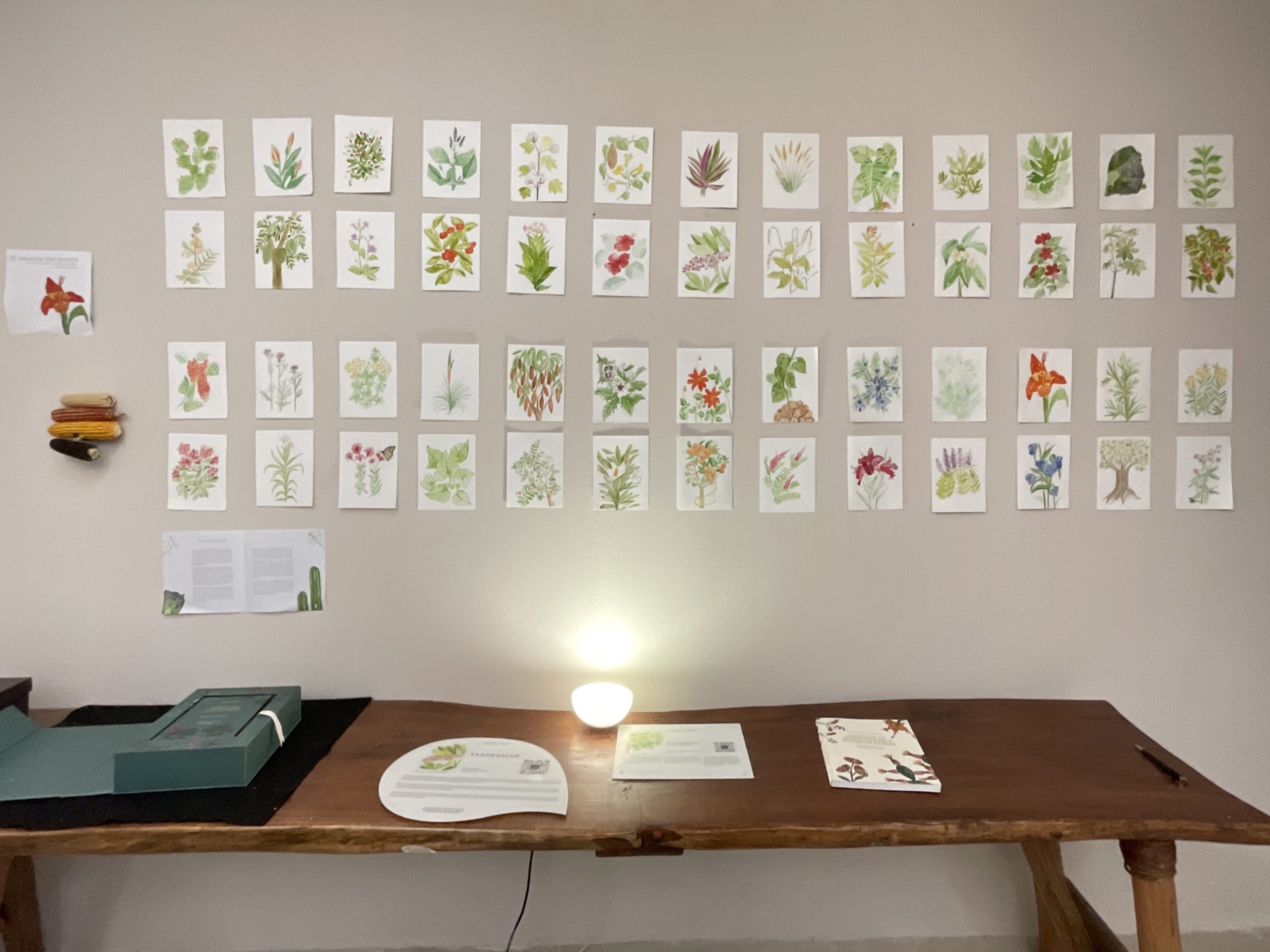
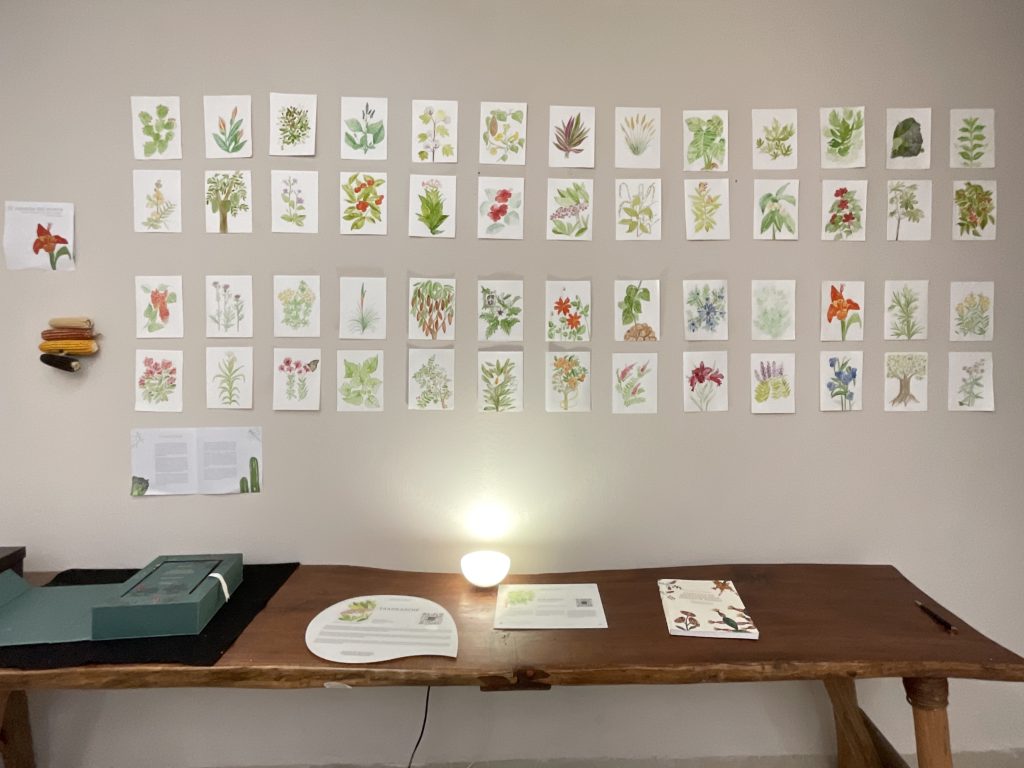
52 Plantas del códice que la Abuela Guadalupe Corona Utiliza y tiene en su casa en Tepeyololco
Acuarelas con Plantas del Códice de la Cruz Badiano 30 metros cuadrados Jardín interior 100 metros cuadrados
La exposición «El corazón del monte» se encuentra exhibida en la Sala de Herbolaria y se basa en las imágenes del Códice De la Cruz-Badiano, una emblemático códice datado en 1552. La artista ha realizado 54 acuarelas de plantas reconocidas en este herbario histórico, buscando aportar una interpretación visual que enriquezca la comprensión de las plantas desde el siglo XVI hasta el presente.
La muestra, se relaciona estrechamente con el Jardín Botánico del Palacio de la Escuela de Medicina. Con la colaboración de la abuela Guadalupe Corona, Cristina Ochoa ha seleccionado especímenes que permitirán a los visitantes reconocer las plantas representadas en sus acuarelas. Este espacio ofrece una oportunidad única para explorar y comprender los usos que aún prevalecen en numerosas comunidades mexicanas.
En conjunto con la inauguración de la exposición, se llevara a cabo una mesa de diálogo con expertas en la materia y que han estado involucradas en estos proyectos. Biólogas, maestras en ciencias, curanderas y artistas compartirán sus experiencias en el desarrollo de estos proyectos, generando una perspectiva multidisciplinaria.